
A Mixed-Use Building: Sustainable and Modern Design
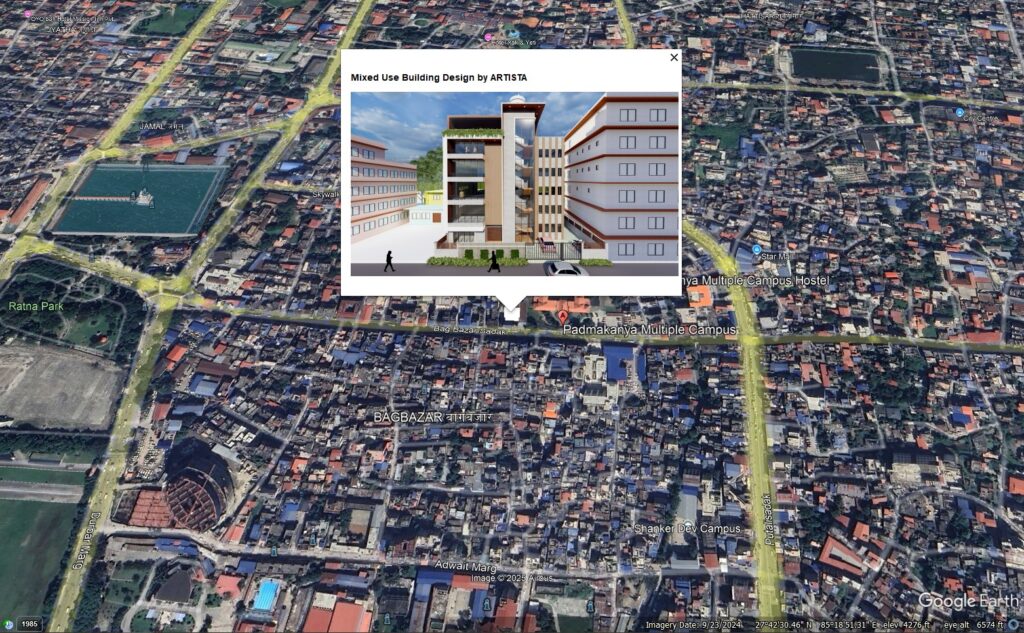
This project, positioned in Ward No. 28 of Baghbazar, Kathmandu, exemplifies a commitment to sustainability and modern architectural design. Covering an area of 4712.10 sq. ft., this site is strategically located on the north side of the prominent 44′ Baghbazar road, a key conduit linking Putali-sadak and Ratnapark. Its proximity to the P.K. Campus building to the east and access via a 14′ wide road to the west enhance its connectivity and convenience. The surrounding residential zone, complemented by a commercial subzone designation, fosters a dynamic yet cohesive neighborhood environment, ideal for the envisioned mixed-use building.
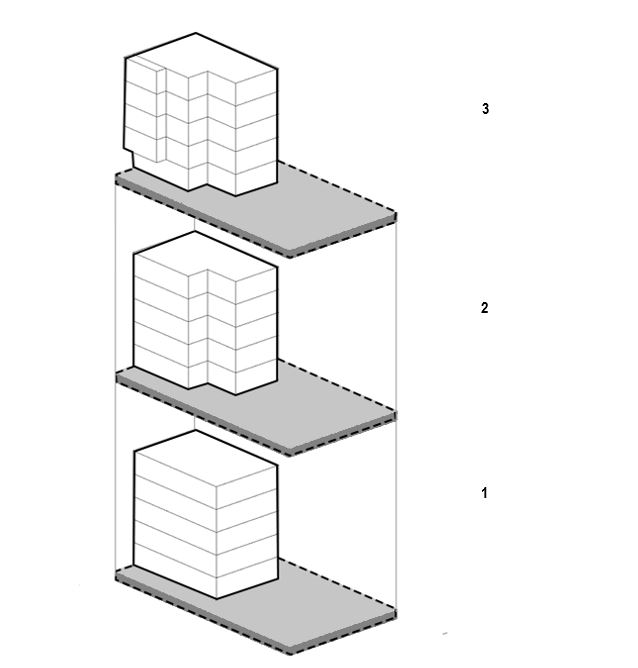
The proposed mixed-use building has been conceived through a volumetric design approach that responds to both functional requirements and contextual influences. The massing diagram illustrates the transformation from a simple block to a more articulated volume across three primary layers. The building is planned as a five-storey structure dedicated to rental use, with specific zoning applied to each level to maximize spatial efficiency and urban connectivity. At the ground level, the south-eastern corner is designated for vehicular parking, ensuring convenient access without disturbing the pedestrian flow. The remaining portion is allocated for a press machine.
The upper storeys accommodate rental units, with thoughtful articulation introduced via recessed balconies on both the eastern and western facades. These not only enhance visual interest but also facilitate cross-ventilation and natural light penetration, thereby improving the living quality. This volumetric transformation, as illustrated in the adjacent diagram, represents the gradual shift from a solid block to a more dynamic mass that responds to site orientation, functional zoning, and user comfort. Each level steps back or opens out, allowing the built form to breathe within the dense urban fabric of Baghbazar while ensuring privacy, climatic responsiveness, and aesthetic coherence.
The architectural design meticulously adheres to local regulations, including a 3′ right of way and required setbacks. With a ground coverage of 60%, covering 2750 sq. ft., the design efficiently balances space utilization and operational efficiency. The centerpiece of the building is a dedicated area for a Heidelberg SM74 5-colour printing press, a heavyweight machine requiring specific spatial considerations. This press, with its dimensions of 20′ by 50′ and weighing 21 tonnes, is housed in a specially designed room, ensuring its operational needs are met.
Beyond the operational space, the building is designed with a focus on functionality and tenant comfort. It includes essential amenities such as staff rooms, wash areas, and public toilets to support a productive environment. The five-storey structure incorporates versatile commercial spaces available for lease. The design also features a well-appointed lobby, complete with a staircase and lift, providing a welcoming common area for all tenants.
The design also accommodates the existing 20-year-old building on the south-east part of the site, making necessary adjustments to improve connectivity with this structure. While neighboring buildings are constructed with concrete, our design utilizes a steel structure, which is both recyclable and sustainable. Steel’s inherent durability, strength, and flexibility contribute to a cost-effective and efficient construction process, avoiding the need for excavation and minimizing project costs.
The building’s aesthetic is marked by a sleek, modern design, with a glazing facade comprising about 50% of the exterior. This facade enhances energy efficiency through effective heat gain and loss management, supported by layered glass with coating panels. The transparency of the glazing not only offers a contemporary look but also aligns with sustainable building practices. The overall design is refined and in harmony with the surrounding structures, ensuring that the new development complements the neighborhood while setting a benchmark for sustainable architecture. The design development for the mixed-use building at Baghbazar has been completed following the initial program formulation. The process involved a series of conceptual explorations, iterative planning strategies, and multiple rounds of discussions and revisions, provided in detail in the Annex. Each stage contributed to refining the spatial configuration, functionality, and architectural expression of the project. The final design integrates commercial and communal functions in a cohesive manner, supported by comprehensive 2D planning and 3D visualization that reflect both contextual sensitivity and user needs.